
What Slows Contract Turnaround Most
A practical blog on what slows contract turnaround most, why delays usually happen outside drafting, and how contract lifecycle management software helps teams improve movement, visibility, and execution.

Introduction
When contracts move slowly, drafting usually gets the blame first.
But drafting is rarely the whole story. In many organizations, the real delay starts after the first draft is ready.
The document is complete, but the process around it is not.
Contract turnaround is shaped by handoffs, approvals, coordination, execution readiness, and post-review movement.
When those parts are scattered, delays become normal.
The right contract management software helps teams reduce friction across the full contract journey, not just at the drafting stage. And that is often where the biggest turnaround gains come from.
Why Drafting is Only One Part of Contract Speed
A contract can be drafted in one day and still take two weeks to close.
That is because turnaround depends on more than document creation. It depends on whether the contract moves cleanly from one stage to the next.
If every stage requires manual coordination, progress becomes uneven.
As a result, contract teams often feel stuck in a pattern where work gets completed, but contracts do not actually move.
What Slows Contract Turnaround Most
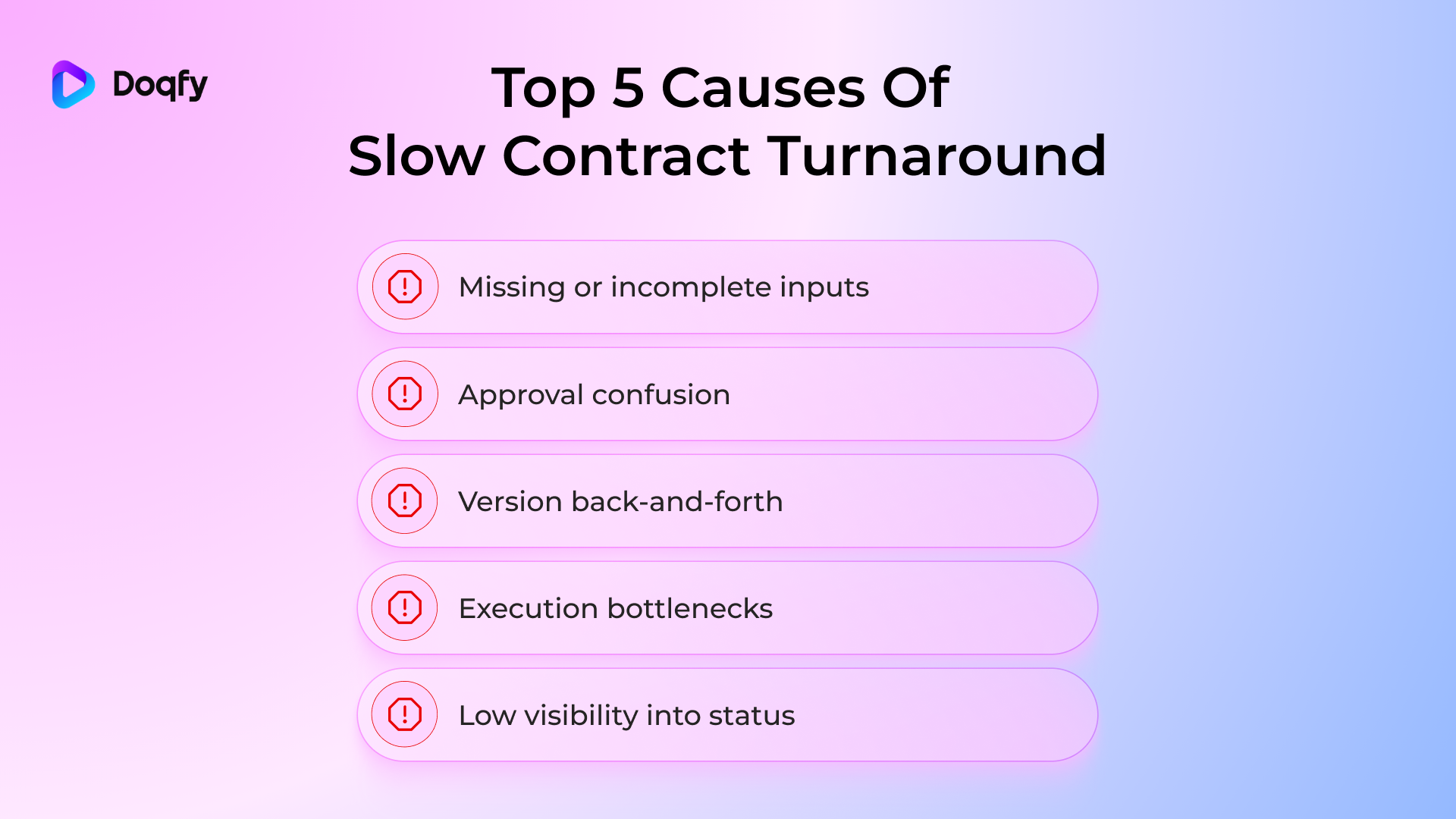
1. Missing or incomplete inputs
- Contracts often enter drafting or review before the commercial and operational details are fully ready.
- That forces teams to pause and rework.
- A contract cannot move cleanly when the basics are still shifting.
2. Approval confusion
- Delay builds quickly when it is not clear who needs to approve, in what order, or under what conditions.
- Teams end up following up manually instead of relying on structured workflow movement.
3. Version back-and-forth
- Multiple drafts moving across email threads create friction fast.
- Teams lose time checking whether they are reviewing the right file instead of progressing the contract itself.
4. Execution bottlenecks
- Even after approvals are done, signing and stamping can introduce another layer of delay.
- If execution is handled outside the main workflow, turnaround slows again right before completion.
5. Low visibility into status
- A contract moves faster when everyone knows what stage it is in.
- When that visibility is missing, teams spend time asking for updates instead of moving the agreement forward.
The Real Bottleneck: Manual Coordination
Most contract delays can be traced to a process that depended too heavily on people to coordinate every step manually.
When the process depends on manual coordination, turnaround becomes unpredictable.
This is why growing organizations often feel that contract work becomes slower even when they add more resources.
Without better workflow design, more volume simply creates more moving parts.
It gives teams a structured way to move agreements through drafting, review, approval, execution, and storage with fewer avoidable delays.
Reduce Turnaround Delays with Contract Lifecycle Management
Faster contract turnaround comes from making the overall contract journey easier to move through.
At Doqfy, that means focusing on the parts of the process where delay builds most often.
- Templates and Clause Library help teams start with approved language instead of rebuilding contracts from scratch each time
- Approval Workflows keep reviews moving through the right stakeholders without relying on manual chasing
- Collaborative Editing with Version History helps teams review and revise in one place without losing track of the latest draft
- eSign, DSC, and eStamping make execution faster once the contract is approved and ready to close
- Centralized Repository with Alerts and Renewal Tracking keeps completed contracts searchable, traceable, and easier to manage after signing
When those parts work together, contract turnaround becomes more consistent and easier to manage at scale.
What better contract turnaround looks like
1. Contracts start cleaner
- Better intake and clearer inputs reduce rework later.
- That improves movement from the beginning.
2. Review moves with more structure
- Teams know what is pending and who owns the next step.
- This cuts delay without creating unnecessary complexity.
3. Execution follows naturally
- Once a contract is approved, it should move smoothly into signing and completion.
- That is where many slow processes break down.
4. Visibility stays intact
- Teams should not need to ask where the contract is or what happened last.
- Stronger visibility shortens response time across the board.
5. Turnaround becomes repeatable
- The goal is not one fast contract.
- The goal is a system that keeps contract movement steady across volume, teams, and agreement types.
Conclusion
What slows contract turnaround most is rarely drafting alone. It is the friction that builds between stages.
These delays quietly stretch timelines and make contract work feel heavier than it should.
That is why improving turnaround means looking at the whole lifecycle and not just the document.
The right contract lifecycle management software helps teams reduce the coordination burden that slows contracts down.
It brings structure to movement and improves visibility across stages.
And it makes contract execution easier to manage as complexity grows.
If your team is trying to improve contract turnaround, the best place to start is not only with drafting speed.
It is with the workflow around it.
Book a demo with Doqfy to see how better contract workflows can reduce delays and help agreements move faster from draft to execution.