
Non-Disclosure Agreements in India: How to Draft, Execute, and Manage NDAs at Scale
NDAs in India are governed by the Indian Contract Act, 1872. Confidentiality obligations are enforceable, but under Section 27 broad post-employment non-competes are void. A strong NDA defines confidential information, sets a reasonable term, and is stamped and digitally executed.


The Document Behind Every Confidential Conversation
Almost every meaningful business conversation eventually runs into an NDA. Founders share roadmaps with investors, employers hand financials to senior hires, vendors exchange source code, and acquirers comb through books during diligence. In each of those moments, the non-disclosure agreement is what turns a verbal promise of secrecy into something a court can actually enforce.
Yet NDAs are also one of the most misunderstood documents in Indian business. Many are copied from generic templates, padded with clauses that Indian courts will not uphold, and signed without being stamped. A signature on a long document does not guarantee protection if the clauses do not hold up. Getting NDAs right, and managing them consistently at volume, is a practical discipline worth understanding.
Why NDAs Deserve Careful Drafting in India
1. An NDA is a contract, so it must satisfy contract law
NDAs are governed by the Indian Contract Act, 1872. To be valid, an NDA needs the essentials of any contract: lawful consideration, free consent, competent parties, and a lawful object. If those are missing, the strength of the confidentiality language does not matter.
2. Section 27 draws a hard line around restraint of trade
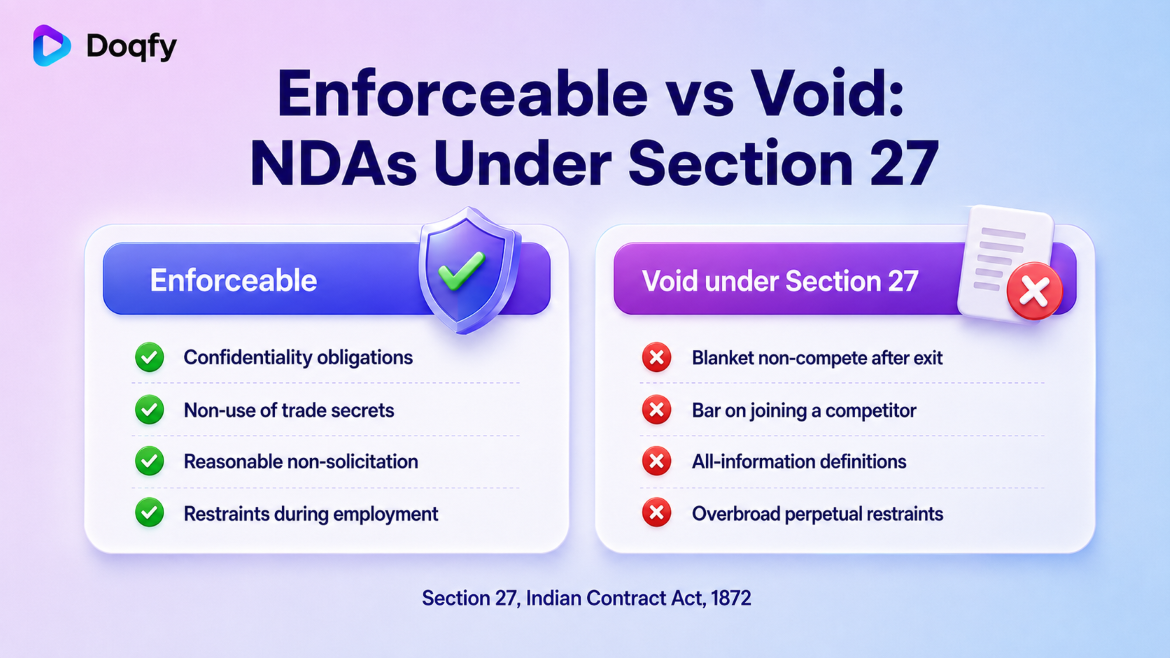
This is the single most important point for Indian NDAs. Section 27 of the Contract Act makes agreements that restrain a person from exercising a lawful profession, trade, or business void to that extent. Indian courts have consistently held that confidentiality and non-disclosure obligations are enforceable, but broad post-employment non-compete clauses that simply bar someone from working in an industry are generally not. The practical rule: an NDA can stop a person from using or disclosing your specified confidential information, but it cannot stop them from taking a new job.
3. Vague drafting weakens even a valid NDA
Courts scrutinize NDAs that define confidential information too broadly or vaguely. An NDA that ties disclosure to a specific purpose and lists what is and is not confidential is far stronger than one that simply says all information is secret.
4. Admissibility depends on stamping
Like other agreements in India, an NDA that is not adequately stamped for the relevant state can face difficulty being admitted as evidence when a dispute arises. Stamping is part of enforceability, not an afterthought.
The Clauses a Defensible Indian NDA Needs
- Parties and purpose. Identify the parties, with company identifiers where applicable, and state clearly why information is being shared, for example to evaluate a potential joint venture. The purpose clause lets you prove misuse if the information is used for anything else.
- Definition of confidential information, with exclusions. Provide a positive list of what is protected and exclusions such as information already public, independently developed, or required to be disclosed by law.
- Obligations of the receiving party. Non-use, non-disclosure, a duty of care, and limits on onward sharing.
- Term and duration. Confidentiality typically runs two to five years after the engagement ends, with longer or perpetual protection reserved for genuine trade secrets. Courts tend to read down open-ended terms for ordinary business information.
- Return or destruction on exit. Require return or deletion of confidential material, including copies and backups, with confirmation.
- Remedies. Provide for injunctive relief, since damages alone rarely undo a leak, along with the right to claim damages. Where liquidated damages are used, they must be a reasonable pre-estimate.
- Governing law and jurisdiction. Choose Indian law and a named jurisdiction such as Mumbai, Bengaluru, or Delhi, and set a clear dispute-resolution route.
How to Execute and Manage NDAs at Scale
1. Standardize a controlled NDA template set
Maintain approved unilateral, mutual, and multilateral templates so every NDA starts from language that holds up, rather than a download of unknown origin.
2. Keep the risky clauses out by default
Bake the Section 27 lesson into the template: strong confidentiality and non-solicitation where reasonable, and no blanket non-compete. This prevents a single overreaching clause from inviting a restraint-of-trade challenge to the whole document.
3. Execute digitally and stamp correctly
Use electronic signatures recognized under the Information Technology Act, 2000 for fast, verifiable execution, and ensure each NDA is stamped as per the applicable state so admissibility is preserved alongside validity.
4. Track expiries and obligations
NDAs have terms, return obligations, and sometimes survival clauses. Tracking these, rather than filing and forgetting, is what keeps protection live.
5. Keep one retrievable record
Store executed NDAs and their versions in a central, permissioned repository, so that when a dispute or a diligence request arrives, the right NDA and its execution trail are retrievable as a single record.
India Guardrails for NDAs in 2026
- Protect information, do not restrain livelihood. Frame obligations around confidential information and reasonable non-solicitation, not blanket bans on future employment, which Section 27 will not support.
- Be specific. Define confidential information and the purpose precisely. Broad, all-encompassing language is the most common reason NDAs fail.
- Stamp for admissibility. Treat stamping as part of execution so the NDA can be relied on as evidence.
- Keep execution sound. Electronic execution is practical under the IT Act, 2000 when signer identity, intent, and record integrity are preserved.
This blog is general information and not legal advice. Have qualified counsel tailor NDAs to your specific business and jurisdiction.
Conclusion
Summing up, an NDA is only as strong as its drafting, its execution, and the record behind it. In India, that means protecting specified confidential information rather than trying to restrain someone's right to work, defining terms precisely, stamping the instrument, and executing it in a way you can prove.
For businesses that sign NDAs constantly, the answer is not more paperwork. It is a controlled template set, digital execution, correct stamping, and a retrievable repository, so confidentiality is consistent and defensible at scale rather than improvised deal by deal.
Explore standardized, audit-ready NDA workflows with Doqfy today!
Sources and References
- The Indian Contract Act, 1872 (India Code, Government of India): https://www.indiacode.nic.in/handle/123456789/2187
- Enforceability of confidentiality agreements and Section 27 of the Indian Contract Act, 1872 (iPleaders): https://blog.ipleaders.in/enforceability-confidentiality-agreements-section-27-indian-contract-act-1872-2/
- Non-Disclosure Agreement format and enforceability in India, 2026 guide (Vakilsearch): https://vakilsearch.com/article/nda-non-disclosure-agreement-format-india-2026/
- Non-disclosure agreements in India, types and breach (Treelife): https://treelife.in/legal/non-disclosure-agreements-in-india/
- Enforceability of NDA and non-compete agreements in India (Sudhir Rao and Associates): https://sudhirrao.com/enforceability-of-nda-and-non-compete-agreements-in-india/
- NDAs: protecting confidential information (Agrud Partners): https://agrudpartners.com/ndas-protecting-confidential-information/
- The Information Technology Act, 2000, on legal recognition of electronic signatures and electronic records (India Code / MeitY)