
Contract Negotiation and Redlining: A Faster, Cleaner Workflow for Legal and Business Teams
The negotiation and redlining stage is where contracts stall, as counterparty edits scatter across email and versions multiply. A faster workflow uses playbooks with fallback positions, a single source of truth, clean redlines, and recorded approvals, cutting cycle time.

The Stage Where Contracts Get Stuck
A contract can be well drafted and still take weeks longer than it should. The delay rarely happens at the first draft or the final signature. It happens in the middle, during negotiation, when versions bounce between parties, edits arrive by email, and nobody is quite sure which draft is current or whether a proposed change is acceptable.
This is the negotiation and redlining stage, and it is where both time and value leak. Research from World Commerce and Contracting has long put the value erosion from poor contracting practices at a meaningful share of annual revenue, and a large part of that erosion traces back to slow, disorganized negotiation. Speeding it up is not about pushing harder. It is about giving legal and business teams a cleaner workflow.
Why the Negotiation Stage Breaks Down
1. Versions multiply and drift
When redlines travel as attachments across email threads, teams quickly lose track of which version is authoritative. Comments fragment, changes get missed, and reconciling drafts becomes its own task.
2. Fallback positions are unclear
When a counterparty pushes back on a liability cap or a payment term, the business often does not know how far it can flex without escalating. Every edit becomes a fresh decision, and every decision waits on someone.
3. Internal approvals lag the live conversation
Negotiation moves in real time, but internal sign-off often does not. A deviation that needs legal approval can stall for days while the counterparty waits, sapping momentum from an otherwise ready deal.
4. The audit trail gets lost
By the time a contract is signed, the record of who proposed what, and who approved each concession, is scattered across inboxes. That is exactly the trail you want if the agreement is ever questioned.
What a Clean Negotiation Workflow Looks Like
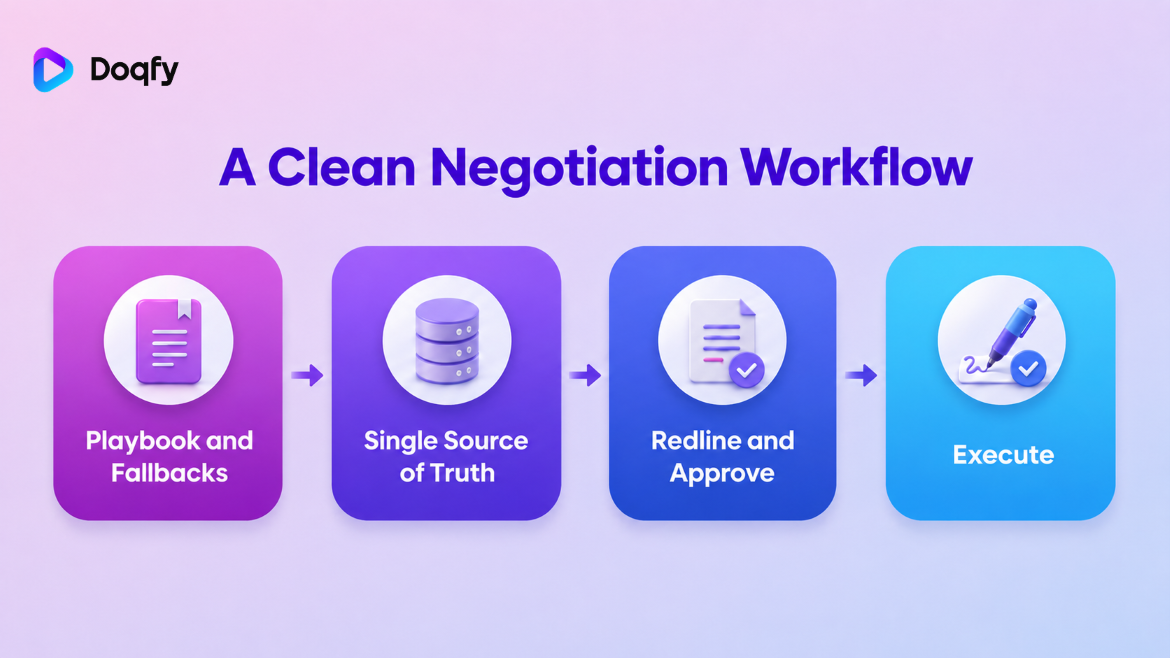
- A clause library and playbook. Pre-approved standard positions and fallback options for common clauses, so teams know the acceptable range before the counterparty responds.
- A single source of truth. One authoritative, current version that everyone works from, rather than competing attachments.
- Reliable redline comparison. Clear, trustworthy tracking of what changed between versions, so review is fast and nothing slips through.
- Structured deviation approval. Rules for which changes can be accepted at the negotiating table and which need sign-off, with approvals captured against the change.
- Legal and business collaboration. A shared workspace where both functions see the same document and comments, instead of relaying edits back and forth.
- A preserved audit trail. A complete, retrievable record of every version, comment, and approval, ready if the contract is later challenged.
How to Put It Into Practice
1. Build playbooks around your real friction points
Start with the clauses that cause the most back-and-forth, such as liability, indemnity, and payment terms, and define acceptable positions and fallbacks for each. This alone removes a large share of escalations.
2. Consolidate negotiation into one place
Move away from email-and-attachment negotiation toward a single environment where the current version, redlines, and comments live together, so version drift stops.
3. Make deviation approval fast and clear
Set thresholds: what the business can agree directly, and what routes to legal. Capture each approval against the specific change so the reasoning is preserved.
4. Connect negotiation to execution
When terms are agreed, carry the final version straight into signing with an electronic signature recognized under the Information Technology Act, 2000, so there is no gap between the agreed text and the executed record.
5. Keep the whole trail
Retain versions, comments, and approvals in a central, permissioned repository, so the negotiation history is defensible and reusable for the next similar deal.
Guardrails for Faster Negotiation in 2026
- Standardize without rigidity. Playbooks should speed decisions, not remove judgment. Leave room for genuine commercial calls while pre-clearing the routine ones.
- Protect shared information. Drafts and attachments exchanged during negotiation can contain sensitive or personal data, so handle them in line with confidentiality and data-protection duties.
- Preserve the record. A clean audit trail of changes and approvals is what makes a negotiated contract defensible later, so capture it as you go rather than reconstructing it.
- Keep execution sound. Electronic execution of the agreed version is practical under the IT Act, 2000 when identity, intent, and record integrity are preserved.
Conclusion
Summing up, the negotiation and redlining stage is where contracts quietly lose time and value. The fix is structure: a playbook with clear fallback positions, a single source of truth, clean redline comparison, fast and recorded deviation approvals, and real collaboration between legal and business.
Teams that run negotiation this way close deals faster and keep a complete, defensible record of how they got there. In a year where legal teams are under pressure to do more with less, a cleaner negotiation workflow is one of the most direct ways to cut cycle time without cutting corners.
Explore a faster, audit-ready contract negotiation workflow with Doqfy today!
Sources and References
- Value erosion from poor contracting practices (World Commerce and Contracting): https://info.worldcc.com/contract-management-aug-2025
- Limitation of liability clauses in Indian contracts and how negotiation deadlocks play out in practice (Mondaq): https://www.mondaq.com/india/contracts-and-commercial-law/1723510/limitation-of-liability-clauses-in-indian-contracts-where-negotiation-deadlocks-meet-judicial-reality
- The Information Technology Act, 2000, on legal recognition of electronic signatures and electronic records (India Code / MeitY)