
Automated Contract Management: What to Automate First (And What Not To)
A practical 2026 guide to automated contract management for enterprises. Covers which contract workflows to automate first, what not to automate too early, and how to prioritize automation within contract lifecycle management and contract management software.

Introduction
Automation has become a crowded promise in contract conversations.
Every platform says it saves time. But most enterprises do not benefit from automating everything at once.
They benefit from automating the right parts first.
Some actions are repetitive and rule-based. Others require legal judgment.
A strong automated contract management strategy begins by separating the two.
The goal is not to remove people from the process. It is to remove avoidable delays and manual coordination. That is where automated contract management creates impact.
For enterprises evaluating contract management software in 2026, the smarter question is not “How much can we automate?”.
It is “What should we automate first today?”
What to Automate First In Contract Workflows
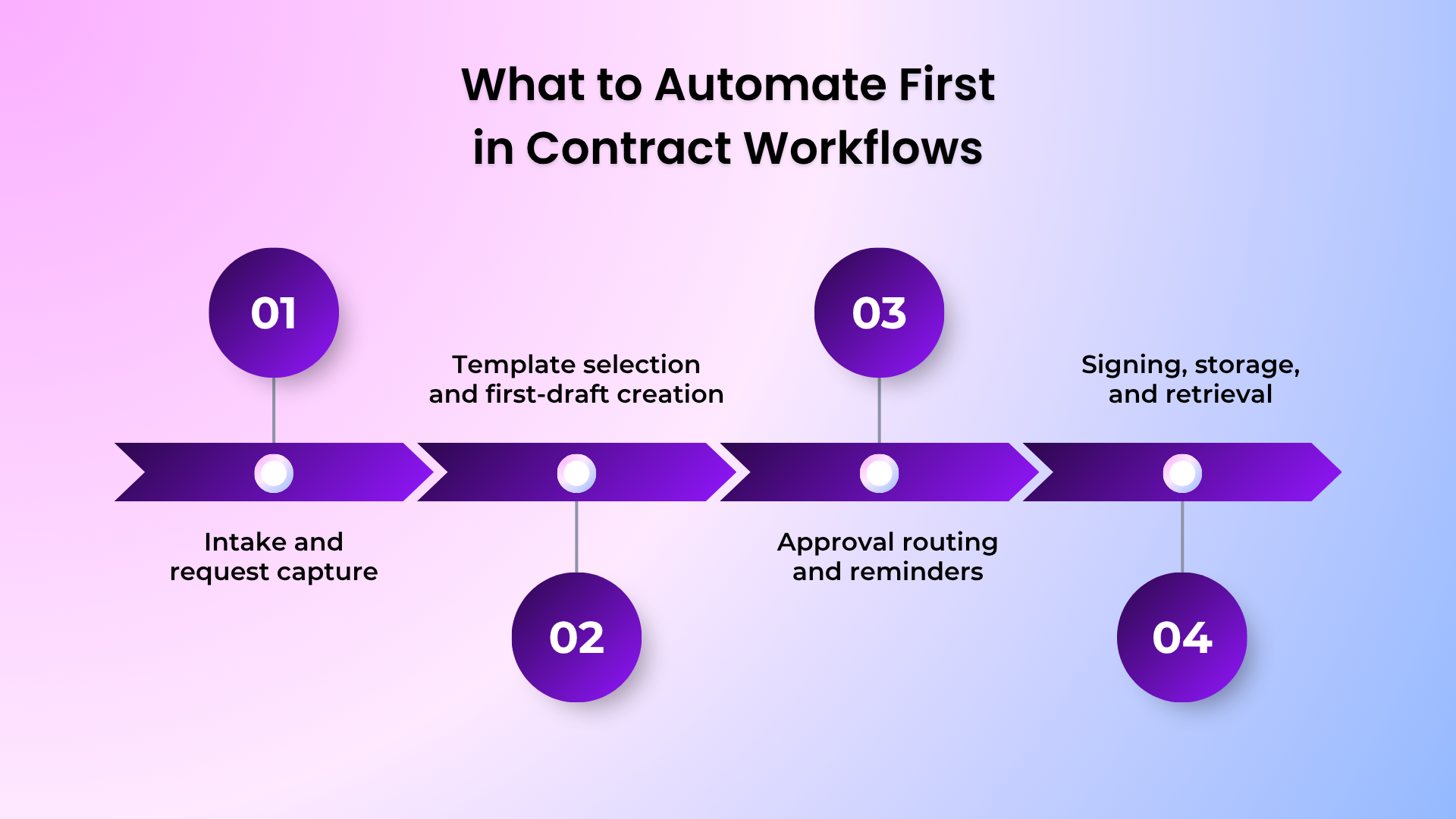
1. Intake and request capture
- Contract requests often begin in scattered emails, calls, or chat messages.
- Automating intake through structured forms creates consistency from the first step.
- Teams can capture request type, owner, urgency, and approvals in one place.
- This reduces rework and gives the contract lifecycle management process a cleaner start.
2. Template selection and first-draft creation
- Standard agreements should not begin from blank pages.
- Contract management software can automate template selection based on deal type or business unit.
- This improves speed and reduces drafting errors.
- It also helps teams maintain clause consistency across high-volume agreements.
3. Approval routing and reminders
- Approval delays are one of the biggest sources of contract slowdown.
- Automated routing can send documents to the right approvers based on value, department, or risk level.
- Reminder nudges and escalation rules reduce dependency on manual follow-up.
- This is often where enterprises see the fastest gains.
4. Signing, storage, and retrieval
- Once a contract is approved, execution should not become another manual bottleneck.
- Integrating eSign and automated storage improves completion speed and record accuracy.
- Tagged repositories make contracts easier to search by customer, date, clause, or status.
- This turns contract management from document parking into active control.
What Not To Automate Too Early
1. Complex redlining and fallback judgment
- Negotiation-heavy contracts often require legal interpretation.
- Automated suggestions can support review, but they should not replace experienced decision-making.
- Pushing full automation too early can create risk when clauses carry financial implications.
2. Exception handling for non-standard deals
- Enterprise contracts rarely stay standard forever.
- Strategic customers and cross-border terms often create exceptions.
- These situations need flexible review paths, not rigid automation.
3. Final accountability for approvals
- Software can route approvals.
- It should not dilute ownership.
- Decision-makers still need to understand what they are approving.
4. Obligation interpretation without context
- Reminders can be automated.
- Interpretation of obligations often cannot.
- Payment triggers or compliance clauses may need context before action is taken.
How Enterprises Should Prioritize Automation in 2026
1. Start with repeatable, high-volume tasks
- Focus first on processes that are frequent, predictable, and easy to standardize.
- Intake, first drafts, approval routing, eSign, and reminders usually offer strong early returns.
2. Measure friction before buying features
- Buyers should identify where delays happen today.
- If approvals are unclear, workflow automation matters more than advanced analytics.
- If retrieval is broken, searchable storage becomes a higher priority.
3. Build for adoption, not just capability
- The best contract lifecycle management system is the one teams actually use.
- Over-automating too early can make the process feel rigid and confusing.
- Good contract management software balances speed with usability.
4. Keep human review where risk is high
- Automation should strengthen governance, not bypass it.
- High-value or highly negotiated contracts still need expert oversight.
Start With What Slows You Down Most
At Doqfy, we have found that the best starting point for automation is usually the part of the process that creates repeated delay: approvals, execution, verification, and visibility after signing.
That is where teams feel the fastest operational improvement. Businesses do not usually need software that tries to replace decision-making. They need software that removes unnecessary operational drag.
With Doqfy’s automated CLM, you get:
- Approval workflows and automated reminders
- Template-based contract creation
- eSign, DSC, and eStamp execution
- Centralized repository with search and retrieval
- Renewal tracking and lifecycle alerts
When businesses try to automate complex judgment too early, the process becomes harder, not better.
But when you automate repetitive execution layers first, contract turnaround improves quickly and teams feel the difference almost immediately.
Conclusion
Automated contract management works best when it follows business logic, not software hype.
Enterprises should automate the steps that create avoidable delay first.
That usually means intake, templates, routing, reminders, signing, and searchable storage.
Those improvements create visible gains without weakening control.
At the same time, complex negotiation, exception handling, and high-risk judgment should remain human-led.
In 2026, the smartest contract management software strategy is not full automation. But practical automation.
If your organization is evaluating where automation can deliver fast value, assess your workflow foundations first.
Book a demo with Doqfy to see how automated contract management can streamline execution while keeping control where it matters most.